
Review · INDONESIA
Bali: Rice Terraces Guided Hiking Experience
The most interesting part of this Bali walk is not simply the green rice terraces. It is the subak irrigation system, a 1,200-year-old way of sharing water that still shapes farming, religion, and daily life. I like the visit to a small agricultural temple and the chance to learn about frogs, fish, crabs, snails, and the many crops growing beside the rice.
I also like that the walk takes place in working fields near Kerobokan rather than at a major viewpoint. Your English-speaking guide, with guides such as Lena leading some departures, explains what you are seeing as you go. A cold coconut or coffee at a simple café is a welcome finish.
The main consideration is scenery. You may walk among houses and see little of Bali’s mountain country, so this is better for understanding local farming than for collecting dramatic terrace photographs. The route also uses narrow walls and bamboo bridges, which calls for steady footing.
Key points to know before booking
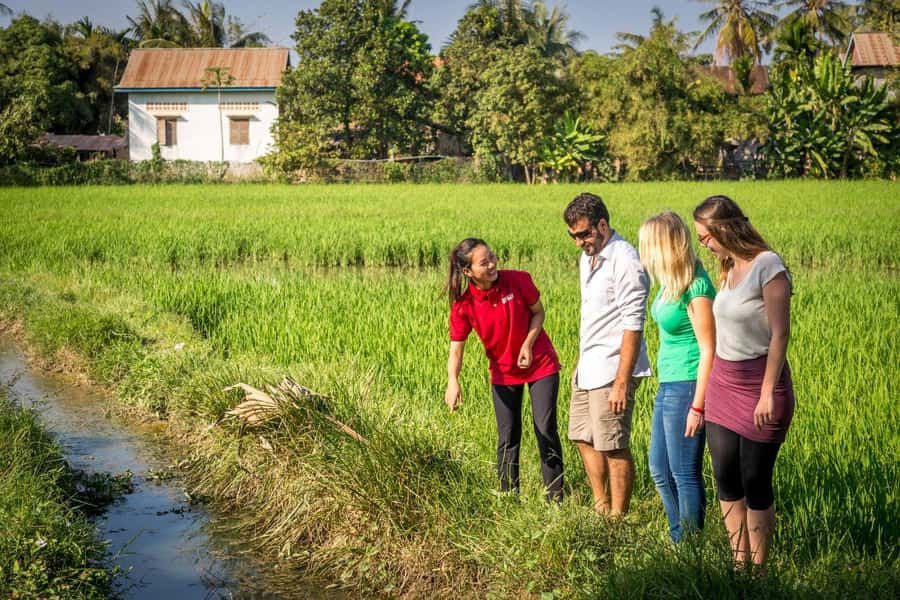
- A working farm walk near Kerobokan: Expect local fields and daily agriculture, not a grand mountain panorama.
- Subak explained on site: Learn how shared water channels support crops, wildlife, temples, and village life.
- A less-visited agricultural temple: The stop gives useful context about farmers and water priests.
- Two to three kilometers on foot: The route follows terrace walls and crosses bamboo bridges.
- A simple local refreshment: Coconut water or coffee, light snacks, and mineral water are included.
- A responsible operator: The three-hour tour is carbon neutral and run by a B Corp certified company.
What this Kerobokan walk is really about
Bali’s rice terraces are easy to admire from a roadside lookout. It takes more effort to understand how they function. This three-hour experience makes the fields the subject of the tour, not just the backdrop for photographs.
You begin at Starbucks Kerobokan and walk toward the rice fields with your guide. The change is gradual. Instead of a bus ride to a famous rural site, you move from a familiar meeting point into a quieter farming area near the tourist zones.
That setting has a practical advantage. You see how rice country and modern Bali sit beside each other. Houses may remain close, and the views may not open toward distant mountains, but the fields are part of an active community rather than a preserved display.
The tour is available as a shared walk or a private outing for your group. A shared departure costs $39 per person, a fair price for a guide, drinks, snacks, the temple visit, a field donation, and roughly three hours of instruction and walking. The private option should appeal to couples, families with older children, or small groups that want to set the pace more easily, though the exact private price is not provided here.
More Rice Terrace Tours in Indonesia
- Ubud: Monkey Forest, Jungle Swing, Rice Terrace, and Water Temple
★ 5.0 · 7,160 reviews - Ubud: Waterfalls, Water Temple & Rice Terraces Private Tour
★ 5.0 · 5,484 reviews - Ubud: Waterfall, Rice Terraces & Monkey Forest Private Tour
★ 4.9 · 4,894 reviews
Starting with subak, Bali’s shared water system
One of the best reasons to book this walk is the explanation of subak. The system was introduced to Bali more than 1,200 years ago and is still used. It is not just a network of channels carrying water to rice plants.
Subak organizes cooperation among farmers. Water must be shared across fields, and the timing of planting and irrigation affects the whole farming area. Your guide explains how this system links practical work with local beliefs and community decisions.
That connection is important. A rice field is not an isolated plot owned and watered without regard for its neighbors. The system creates a set of relationships between farmers, water sources, temples, crops, and animals. Once you understand that, the terraces look less like a pretty pattern and more like a working social system.
The guide also explains the role of water priests. Their work honors the relationship between people, the Earth, and the gods. You do not need a background in Balinese religion to follow the story. The value is seeing how spiritual practice and farming are joined in ordinary community life.
A small subak temple with a local purpose
The temple stop is one of the more unusual parts of the route. This is a subak agricultural temple used as a gathering place for farmers, rather than one of Bali’s headline attractions.
Keep your expectations in check. The appeal is not grand architecture or a long visit filled with formal ceremony. It is the chance to understand why a farming community maintains a temple connected to water and crops.
Your guide gives the temple a clear role in the wider farming system. You learn how farmers honor the water supply and how local religious practice supports cooperation. This makes the later walk through the fields easier to read.
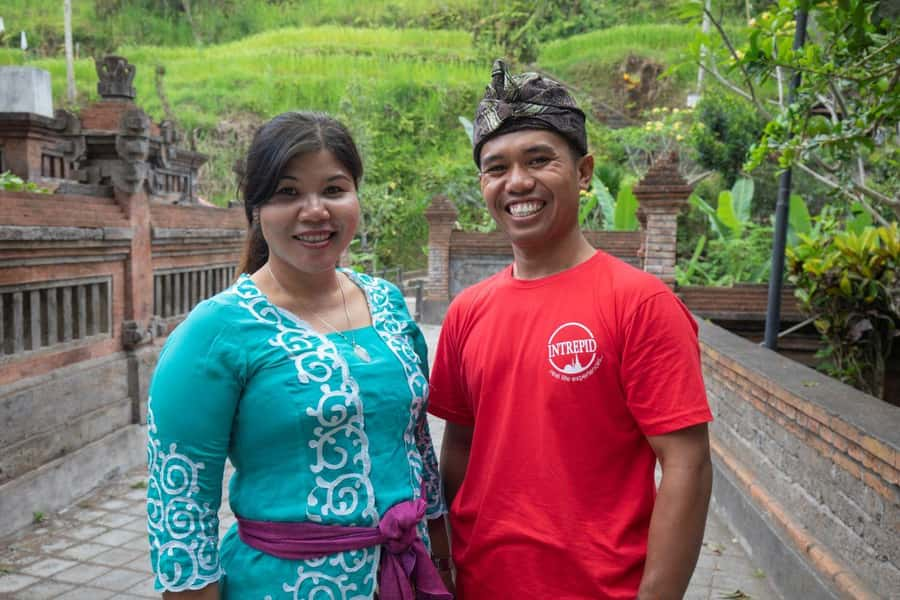
As with any religious site, follow your guide’s instructions and dress in comfortable, respectful clothing. The tour includes an udeng for men or a sash for women, giving you a small connection to local custom during the experience. It is a gift, not a substitute for proper behavior at the temple.
Walking two to three kilometers across the terraces
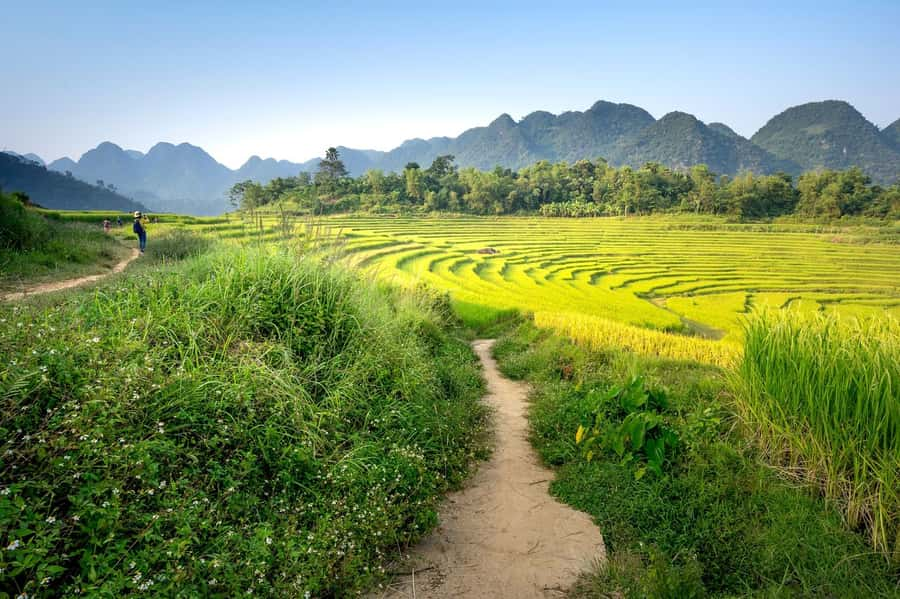
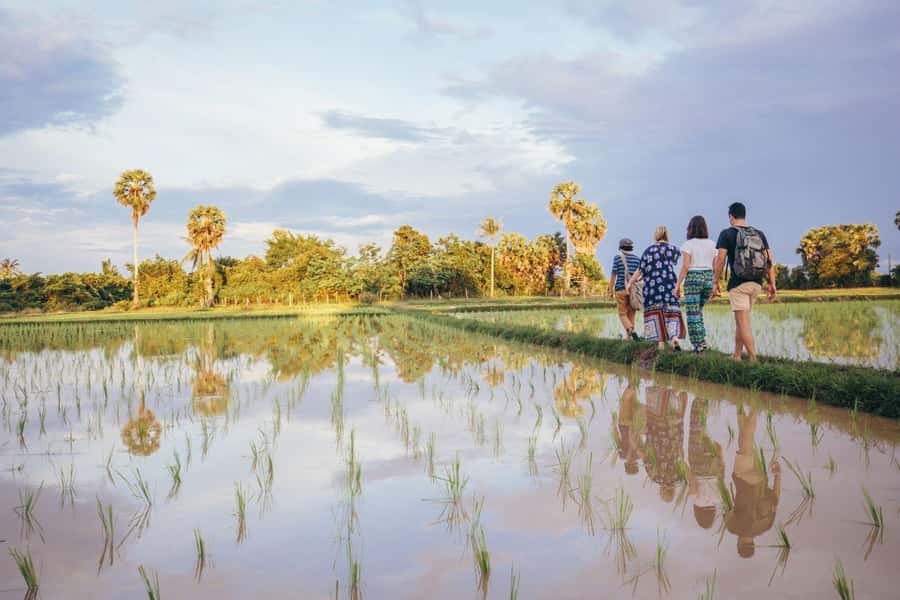
After the temple, the tour enters the rice fields. The walk covers about two to three kilometers, generally along the tops of the walls dividing one field from another.
This is not a paved promenade. The footing can be narrow, uneven, or damp, depending on conditions. You may cross small rivers on farmers’ bamboo bridges, so comfortable shoes are essential. The provided advice to wear comfortable clothes and shoes is practical, not filler.
I would avoid treating this as a hard hike, but you should be happy walking outdoors for several hours. The route asks for attention rather than speed. Watch where you place your feet, especially at field edges and bridge crossings.
The pace is shaped by explanation. You stop to look at water channels, crops, and signs of animal life. The guide may point out how a field is managed or explain the task of farmers working in the area. One especially useful detail is that rice is only part of the farm system.
Along the route, you can learn about tomatoes, beans, bananas, eggplant, chilies, corn, sugar cane, and water snails. This helps correct the common impression that every terrace is planted only with rice. Farming here is varied, and the surrounding plants support food production in different seasons.
Same fields, a different sort of day out:
- Ubud: Full-Day Rice Terrace, Monkey Forest & Waterfall
★ 5.0 · 2,634 reviews - Full-Day Tour to Water Temples and UNESCO Rice Terraces in Bali
★ 5.0 · 2,539 reviews - Ubud: Balinese Cooking Class at an Organic Farm
★ 5.0 · 1,786 reviews - Ubud: Monkey Forest, Ceking Rice Terraces and More– Full Day
★ 4.7 · 917 reviews
Spotting frogs, fish, crabs, and snails
The tour also treats the rice fields as living water systems. Frogs, fish, crabs, and snails may share the channels and flooded plots with the rice. Your guide explains how these species fit into the farming environment.
This is a useful feature for anyone who wants more than a scenic walk. You begin to look at the shallow water, muddy banks, and drainage channels with more interest. A frog or snail is not just a random sighting. It can be part of the wider system that supports the fields.
You should keep expectations realistic. The tour does not promise a wildlife-spotting session, and no particular species is guaranteed. The value comes from learning what may live in the fields and why biodiversity matters to local agriculture.
The walk also gives you a better sense of the farmers’ work. Rice growing involves water control, planting, harvesting, and field management, while the surrounding crops and animals add to the farm’s output. Your guide fills in the details as you move.
What the views are like near Kerobokan
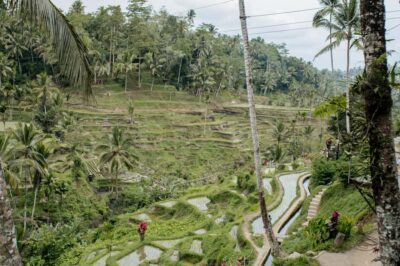
This is where the tour deserves an honest warning. Bali’s most famous terrace images often show broad slopes with mountains in the distance. The Kerobokan route may not offer that kind of view.
The fields can be surrounded by houses, and one account of the route found no mountains visible. If your main goal is a wide photo with dramatic peaks, you may prefer a different rice terrace destination.
That does not make this walk a poor choice. It simply offers a different kind of scenery. You see working fields, narrow paths, local buildings, irrigation channels, and the everyday edge between rural life and development.
I would choose this experience for its explanations and access to ordinary farming areas. I would not choose it solely for postcard views. The distinction matters, especially if you are comparing it with a photo-focused excursion elsewhere in Bali.
The guide makes the difference
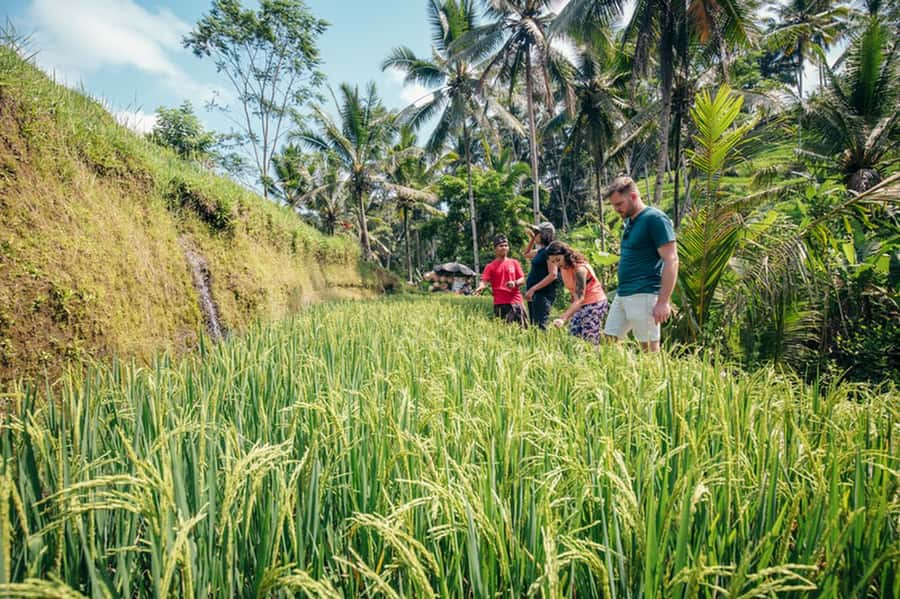
The quality of this experience depends heavily on the guide. The strongest part of the outing is the interpretation: how clearly someone explains the subak system, the temple, the crops, and the wildlife.
Guides such as Lena have been singled out for explaining the subject clearly and making the outing pleasant. A local guide also joins the experience and can add direct insight into farm work and village customs. The combination of an English-speaking activity guide and local knowledge is useful here because much of the value lies in context.
A friendly guide can also make the narrow paths and crossings easier to manage. You will want someone who points out where to step, gives you time to look around, and answers basic questions without rushing.
The guide cannot change the setting. If the day offers houses instead of mountain views, a good explanation will not turn it into a famous scenic lookout. What it can do is help you understand what you are seeing, which is the central purpose of this tour.
Coconut water, coffee, and a simple finish
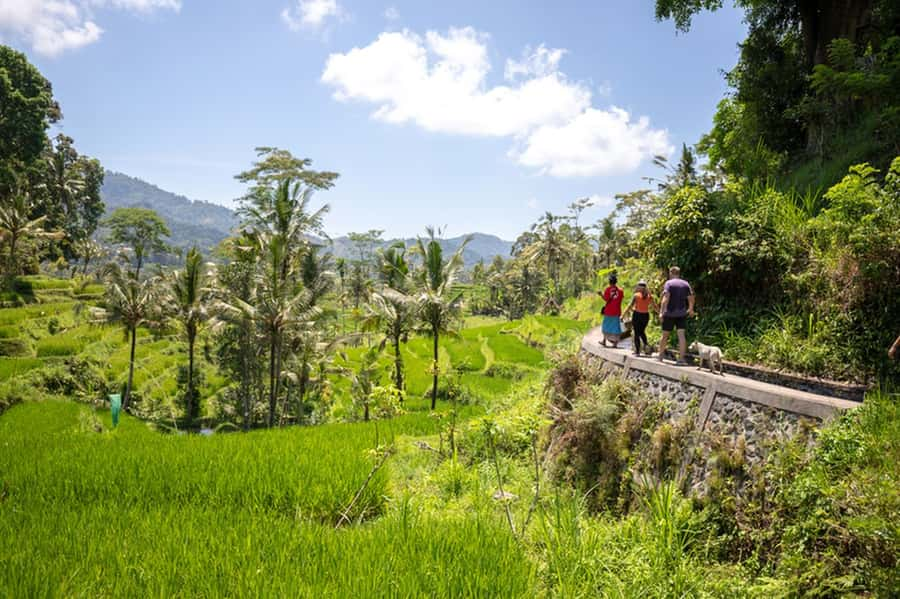
After the walk, you stop at a small café for coconut water or coffee and light snacks. Mineral water is also included.
This is a modest finish, not a full meal. If you need substantial food, bring that expectation and budget for additional food or drinks, which are not included. The café stop works well because it gives you time to cool down and talk through what you have seen.
The choice between coconut water and coffee suits the setting. Coconut water is refreshing after walking in warm conditions, while coffee gives you a familiar break. The light snacks add a little food but should not replace breakfast or lunch planning.
The activity ends back at the Starbucks Kerobokan meeting point. Since there is no included transport to or from your hotel, you need to arrange your own way to the start and allow time to arrive there.
Is $39 a fair price?
At $39 per person, this is good value if you want a guided introduction to Balinese farming. The price includes a local English-speaking guide, mineral water, coconut water or coffee, light snacks, the field donation, and the cultural gift.
The donation matters because the walk uses working agricultural areas. It is a small but useful part of the cost, helping acknowledge the land and community involved in the experience.
You are also paying for interpretation rather than transportation or a major attraction ticket. If you only want to wander through rice fields and take photographs, you may find the price less compelling. If you want someone to explain the irrigation system, crops, temple, and wildlife, the fee is easier to justify.
The carbon-neutral format and B Corp certification may also matter to you. The operator is committed to using travel as a force for good, and this tour supports that approach. Still, responsible branding should complement the actual experience, not replace clear expectations. Here, the main benefit remains the small-scale, agriculture-focused walk.
Who should book this experience?
I would recommend it to first-time visitors who want a useful introduction to Bali beyond beaches and shopping areas. It also suits anyone interested in food production, local religion, water management, or village life.
Photography fans should book only if they value close-up details and local scenes more than big views. The fields may be attractive, but houses and limited mountain views can reduce the dramatic effect.
The walk is not suitable for children under six. Older children may enjoy the animals, crops, bridges, and stories, but adults should consider how comfortably they can manage narrow field paths.
Choose the private option if you want more control over the pace or are traveling with your own group. Choose the shared outing if you are happy meeting other participants and want the lower stated price.
You should also bring comfortable shoes and clothes. There is no need to pack a long list of special gear, but footwear with a secure grip is a sensible choice for terrace walls and bamboo bridges.
Should you book the Kerobokan rice terrace walk?
Book it if you want to understand how Bali’s rice fields work, not just photograph them. The subak system, agricultural temple, local crops, and small ecosystem give the tour real substance, and the guide is central to making those details clear.
Skip it if your priority is a grand mountain view or a polished sightseeing route. Kerobokan can feel built up around the fields, and the paths are practical farm routes rather than scenic walkways.
For $39, I think this is a worthwhile short outing for curious visitors who value local context. Go with comfortable shoes, a flexible view of the scenery, and an appetite for learning. You will come away with a better understanding of why Bali’s rice terraces matter, even if your best photograph is not a sweeping panorama.
FAQ
How long does the rice terrace tour last?
The activity lasts three hours.
Where does the tour start?
Meet at Starbucks Kerobokan.
Where does the tour finish?
The walk ends back at the meeting point at Starbucks Kerobokan.
How far do you walk through the rice fields?
The trek through the terraces covers about two to three kilometers.
What language is the tour conducted in?
The tour is conducted in English with a live English-speaking guide.
Is the tour shared or private?
You can choose between a shared tour with other participants and a private tour for your own group.
What is included in the price?
The price includes a local English-speaking guide, mineral water, coconut water or coffee, light snacks, a rice field donation, and an udeng for men or sash for women.
Are food and drinks beyond the included refreshments covered?
No. Additional food and drinks are not included.
Is the tour suitable for young children?
The activity is not suitable for children under six years old.
Can I cancel the booking?
You can cancel up to 24 hours in advance for a full refund. You can also reserve now and pay later.
More Walking and Hiking Trips in Indonesia
- Selogriyo Temple and Trekking Java Rice Terraces, hidden waterfall -Nature Java
★ 5.0 · 179 reviews - Yogyakarta: Selogriyo Temple Tour & Java Rice Terrace Trek
★ 5.0 · 175 reviews - Ubud: Rice Terrace, Holy Water Temple & Waterfalls Trek Tour
★ 4.9 · 115 reviews - Mount Batur Sunrise Trekking and Rice Terrace Adventure
★ 5.0 · 111 reviews
Just added around Indonesia
- Ubud Rice terrace,Zip-line and waterfall★ 5.0 · 4 reviews
- Full Day Tour to Water Temples UNESCO Rice Terraces in Bali★ 5.0 · 4 reviews
- Explore Ubud Art Market, Monkey Forest and Rice Terraces★ 5.0 · 16 reviews
- Exploring Munduk Village (Waterfalls, rice terrace, Traditional local house)★ 4.5 · 2 reviews
- Ubud Monkey Forest Rice Terrace Temple Waterfall Private Tour★ 5.0 · 7 reviews
- Jatiluwih Spiritual Journey of Melukat with Rice Terrace View★ 5.0 · 9 reviews
- Private Tour to Sumampan Waterfall, Monkey forest, Rice terraces and Swing★ 5.0 · 30 reviews
- Discover Hidden Waterfall, Unesco Rice Terraces and Mountain Temple★ 5.0 · 17 reviews
Indonesia Farm Tours, compared.
Monkey Forest, Jungle Swing, Rice Terrace, and Water Temple
Read our review →
Waterfalls, Water Temple & Rice Terraces Private Tour
Read our review →
Waterfall, Rice Terraces & Monkey Forest Private Tour
Read our review →
Full-Day Rice Terrace, Monkey Forest & Waterfall
Read our review →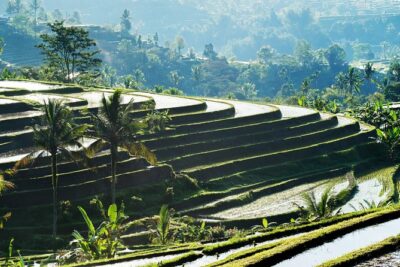
Full-Day Tour to Water Temples and UNESCO Rice Terraces in Bali
Read our review →
Monkey Forest, Ceking Rice Terraces and More– Full Day
Read our review →
Browse the lists this tour appears in