
Review · CHINA
Chengdu Dujiangyan Leshan Buddha Tea Plantation and Sichuan Cooking 3 Days
The best part of this three-day trip is its variety. You move from panda breakfast time and an ancient water system to a giant cliff-carved Buddha, a 500-year-old town, tea fields, and a Sichuan cooking class. The route gives you far more than a quick city tour.
I like the personal side of the program, especially the visit to an old courtyard home and the chance to talk over tea with local people. I also like that your tea picking is not just a photo stop: you use the leaves later in the cooking experience. The main drawback is the amount of time spent in the vehicle, particularly on the long Leshan day.
Key points at a glance
- Pandas before the crowds: Start early at the research base for feeding and play time, with a chance of seeing young pandas.
- Two major UNESCO sites: Visit the Dujiangyan irrigation system and the Leshan Giant Buddha.
- Real local contact: Walk through traditional workshops, enter a family courtyard home, and share tea in an old teahouse.
- Tea from field to cup: Pick tea in Jiajiang, visit a tea-making family, and take your leaves to the cooking class.
- Hands-on Sichuan food: Make noodles, steamed beef with fried rice flour, spicy lotus roots, and your own chili oil.
- Small-group format: The maximum group size is 15, with hotel pickup, an air-conditioned vehicle, and an English-speaking guide.
Why this Chengdu trip feels different
Many Chengdu excursions focus on pandas and perhaps one major sight. This one links the city to Sichuan’s foodways, tea country, village life, and engineering history. That wider view is its real strength.
You begin with a famous animal, but the next three days keep shifting the subject. Dujiangyan shows how people controlled water more than 2,000 years ago. Leshan reveals a huge Buddhist monument carved into a cliff. The old town and tea plantation then bring the scale down to workshops, kitchens, family stories, and everyday customs.
I especially like the way food connects the itinerary. You eat local dishes in Leshan, visit a spice market in Chengdu, and later turn those ingredients into a meal. It gives the cooking class a useful context rather than treating it as a stand-alone tourist activity.
The cost is $433.85 per person. That is not a budget sightseeing ticket, but it covers three days of transport, an air-conditioned vehicle, an English-speaking guide, the panda center, the Dujiangyan admission, the boat at Leshan, lunches, dinner, the tea visit, the cooking class, beverages during the class, recipes, and a cooking souvenir. For a private car and personal guide, you might find cheaper options. For a small group covering this much ground, the price can make sense, especially if you value convenience and local access.
More Plantation Tours in China
- Half-Day Hangzhou Yunxi Bamboo Forest and Tea Plantation Experience
★ 5.0 · 22 reviews - Half-day Tour: Largest Tea Plantation & Amazing Xianggong Hill
★ 5.0 · 9 reviews - Experience Chengdu: Private Tea-Making Day Tour of Mengdingshan Tea Plantation
★ 4.5 · 7 reviews
Day one: pandas and the Dujiangyan water system
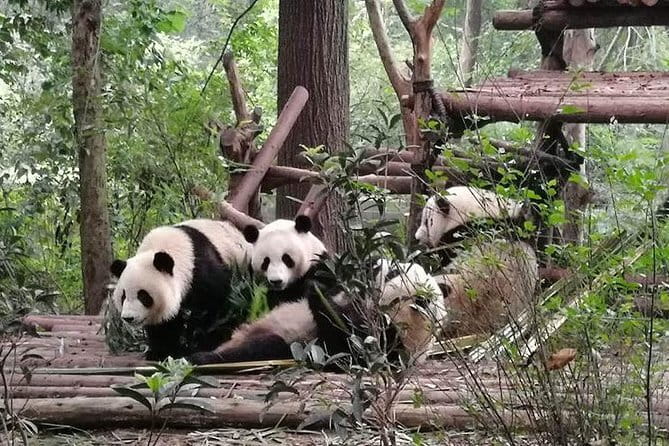
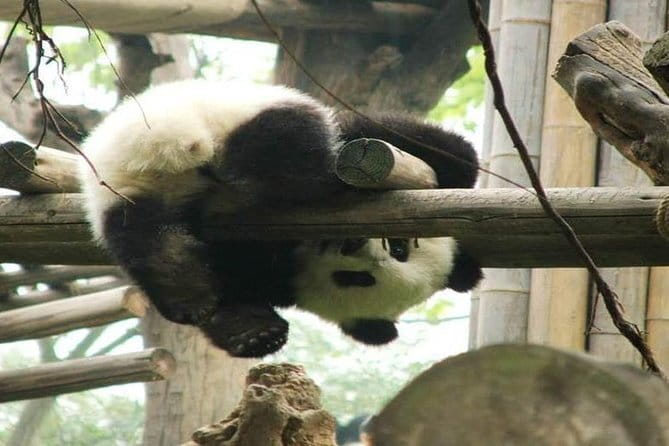
Your guide meets you at your hotel at 7:30 a.m. The drive to the Giant Panda Breeding Research Base takes about 1.5 hours, so charge your phone before leaving. You will use it often. The park has pandas, red pandas, and a panda nursery, and the schedule is aimed at the animals’ morning feeding and play period.
Allow about two and a half hours here. The early timing matters because pandas are most active around breakfast, while warmer parts of the day can be less lively. The tour description gives you a chance to see baby pandas, but that depends on what is happening at the nursery on the day of your visit.
The base is more than a quick animal viewing stop. Your guide explains the pandas and their place in local culture, helping turn a charming encounter into a clearer look at breeding and care. Still, this is a popular attraction, and your experience will depend partly on animal behavior and park conditions. Do not expect every panda to perform on cue.
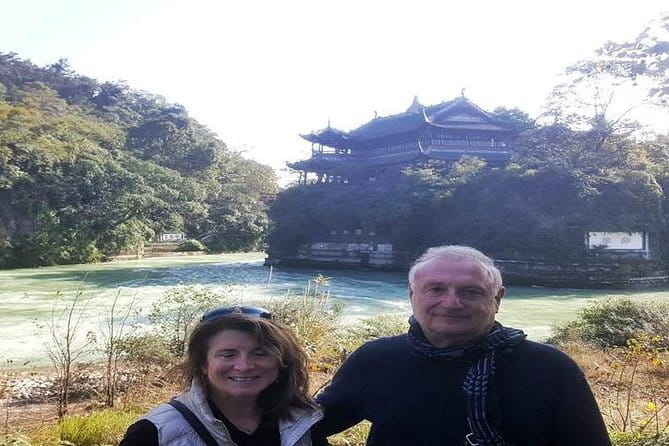
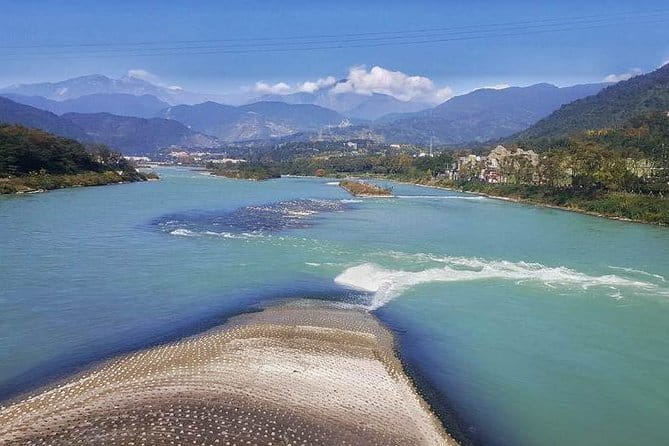
After the panda center, the drive to Dujiangyan takes about 30 minutes. You spend roughly two and a half hours in the irrigation park, where the focus shifts from wildlife to ancient engineering. The site includes old bridges, temples, local scenery, and views toward distant mountains when conditions allow.
Dujiangyan is valuable because it lets you see how a working water system shaped the region. Instead of simply looking at an old structure, you learn the story behind the irrigation project and why it remains an important part of Sichuan’s past. The surrounding park also gives the day some breathing room after the busy panda base.
A golf cart is not included, so you should expect to walk through the park. That extra cost is optional, but the walking route is part of the experience. Comfortable shoes will help.
Day two: Leshan’s giant Buddha by boat
Day two begins with hotel pickup and a much longer drive, about 2.5 hours each way to Leshan. That is the day’s main practical issue. The payoff is the Leshan Giant Buddha, one of Sichuan’s major cultural sights.
The visit includes a boat trip for a broad view of the Buddha. From the water, you can take in the scale of the statue and its position beside the river without making the climb to the viewing area. The boat admission is included.
The stop itself lasts about 50 minutes, so the visit is focused. You are not paying for an extended climb or a long temple circuit. Climbing access is not included, and the schedule is built around the boat view. If standing close to the statue or climbing through the site is your main goal, check the arrangements before booking.
The boat is a smart choice for a short visit because it gives you a clear overall view. It also makes the enormous scale easier to understand than a close-up view from the base. Bring your phone or camera, but keep the visit about seeing the monument rather than trying to record every second.
Suji old town, workshops, and a courtyard home

After Leshan, you drive about 40 minutes to an old town where traditional life has not been fully replaced by modern development. You have about two and a half hours to walk the streets, eat lunch, and visit local places.
This is one of the most appealing sections for anyone who prefers daily life to polished attractions. The route includes traditional workshops such as a blacksmith’s shop, bamboo workshop, and barber shop. These are simple businesses, but they show how skills and services fit into an older town community.
You also stop at an old teahouse. Tea here is not just a drink between sightseeing stops. It is a way to sit, talk, and watch the social life of the town. Your guide helps with the conversation and explains the customs, which matters when language differences might otherwise keep the visit at a distance.
The visit to a century-old courtyard home adds another personal layer. The owner shares stories about the house, and you get a sense of how a family connects its memories to a physical place. This kind of stop cannot be measured by a checklist, but it is often the part that stays with you after the famous sights blur together.
Lunch is included, with local Leshan food drawing on Sichuan flavors. The food can be spicy, and the tour specifically mentions dishes such as rice jelly with a spicy topping and Chinese bacon with grilled garlic shoots. If you enjoy strong seasoning, this is a good chance to try food in the region where it belongs. If you are sensitive to chili, ask your guide for help before ordering or tasting.
More Tea Plantation Tours in China
- Hangzhou West Lake and Tea Plantation Half Day Tour
★ 5.0 · 4 reviews - Private Tour: Yao Mountain and Tea Plantation from Guilin
★ 4.5 · 4 reviews - Qixianfeng Tea Plantation Tour in Yangshuo
★ 4.6 · 4 reviews - Half-Day Hangzhou Jiuxi Stream and Tea Plantation Experience
★ 5.0 · 2 reviews
Jiajiang tea country from leaf to workshop
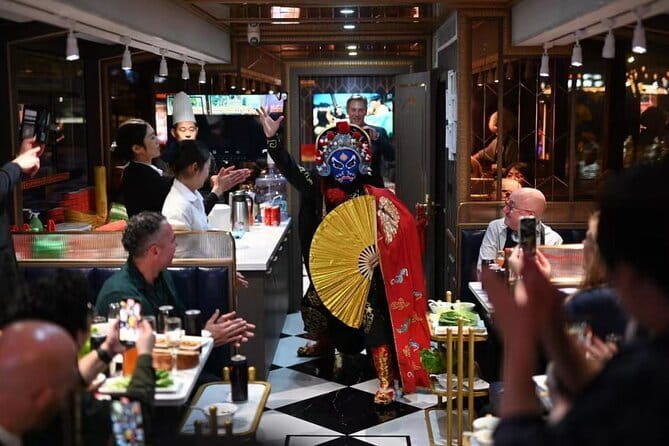
A short drive takes you into the hills of Jiajiang County. Here, a tea farmer explains how to choose good sprouts and buds, how weather affects the crop, and why tea varies by region. You also get to pick tea yourself.
This is a hands-on stop, but it is not a full farming day. The tea visit lasts about 1.5 hours, including the field and the workshop. You then visit a tea-making family to see how the leaves are processed into different kinds of tea.
The best detail is the connection between the plantation and the next day’s cooking class. You are asked to bring the tea you picked, then use it later. That gives the activity a clear purpose. It also helps you understand tea as an agricultural product, not simply something served in a cup.
At the farmhouse, you sit and taste tea while hearing more about the crop and the family business. The comparison to wine is useful: tea has different varieties, growing regions, and ways of processing. You will not become a tea expert in one afternoon, but you will leave with a better vocabulary for what you are drinking.
Day three: a Chengdu market challenge
The final day stays in Chengdu. Your guide meets you at the hotel and takes you to a local spice market, where you have an assigned challenge to find ingredients for the cooking class.
This adds some playful purpose to the market visit. You are not only walking past piles of spices. You have to pay attention, identify ingredients, and gather items that will later be used in the kitchen. The activity is scheduled for about two hours and includes a walk through back streets for local food at lunchtime.
The market section is best for people who like food with a story. Sichuan cooking depends on more than heat. Spices, aromatics, sauces, texture, and preparation all matter. Seeing ingredients before cooking them makes the later lesson easier to follow.
Lunch is included, but the supplied details do not specify the exact menu. The route describes it as local street food in the back streets, so keep an open mind. This is not the place to expect a familiar Western lunch.
Cooking Sichuan noodles, beef, lotus roots, and chili oil

After lunch, you go to a traditional Sichuan courtyard restaurant for a 2.5-hour cooking class. The tea service begins with Sichuan gaiwan tea, a local custom used to welcome guests. It is a useful pause before the practical work starts.
A professional chef guides you through the preparation. You make Sichuan-style noodles, steamed beef with fried rice flour, spicy lotus roots, and your own spicy chili oil. The class is not just a demonstration. You follow instructions and process the food yourself.
I like the menu because it covers several techniques and textures. Noodles teach you about seasoning and mixing. Steamed beef with rice flour shows a different preparation method. Lotus root adds a crisp vegetable dish, while chili oil gives you a key Sichuan building block that you can use again at home.
Beer or tea is provided during the cooking class. Recipes and a special souvenir are also included, which makes the class more useful after your return home. The tea you picked in Jiajiang connects back to this final activity, though the supplied details do not specify exactly which prepared dish uses it.
The class is a good choice if you want to learn rather than simply eat. It may be less appealing if you prefer a relaxed restaurant meal with no scheduled activity. The timing is fixed, and you will need to keep pace with the chef and the rest of the group.
Transport, group size, and daily pace
The tour uses an air-conditioned vehicle and offers hotel pickup. The maximum group size is 15, which is small enough for questions but not the same as a private tour. A guide can usually give more attention in a group of this size, especially during the market, tea, and cooking portions.
The road time is the biggest factor in deciding if this trip suits you. Day one includes about 2 hours of driving in total, while day two is built around a 2.5-hour drive to Leshan plus the return journey. The long transfers are reasonable for the distance covered, but you should not book this expecting three slow, local days.
Most people can participate, and the activity is near public transportation, though hotel pickup is offered. The itinerary includes regular walking in parks and old streets. The optional Dujiangyan golf cart is not included, and climbing at the Leshan Buddha is also not part of the price.
Bring comfortable shoes, a charged phone, and room for the tea and cooking souvenir. You may also want a small bag for the tea leaves you pick.
The guide can shape the experience
The guide is an important part of this program because several stops rely on explanation and conversation. Lucy is specifically identified as an English-speaking guide, and her role includes more than moving the group from one attraction to the next. She helps explain pandas, the irrigation system, tea production, local food, and the stories shared in the old town.
The experience also depends on local hosts: the tea farmer, the tea-making family, the courtyard home owner, workshop artisans, and the cooking chef. That mix gives the trip a human scale. You are not only looking at monuments from behind a barrier.
Two posted five-star ratings particularly praise Lucy’s friendly manner and the driver’s service on a long Leshan, village, and tea day. That fits the structure of the tour: a good guide and steady driving matter when the schedule includes early starts, rural roads, and long transfers.
Who should book this three-day tour?
I would choose this trip if you want Chengdu to mean more than pandas and hot pot. It suits you if you enjoy food, tea, small workshops, local stories, and UNESCO-listed sights, and if you are happy to trade some free time for an organized route.
It is also a strong option for first-time visitors who do not want to arrange several out-of-town journeys on their own. The included vehicle, guide, admissions, boat, meals, tea visit, and cooking class remove much of the planning work.
I would think twice if you dislike early starts, long drives, spicy food, or fixed schedules. A private tour might suit you better if you want to linger at Leshan, spend more time at the panda base, or change the order of stops. Also note that gratuities are not included, though they are recommended.
Free cancellation is available up to 24 hours before the start time. Poor weather or failure to meet the minimum group size can lead to a new date, another experience, or a full refund.
Should you book it?
Book it if you want a three-day Sichuan sampler that links wildlife, engineering, religion, tea, village life, and cooking. The strongest parts are the personal old-town visits, the tea picked and tasted in Jiajiang, and the final class that turns the region’s ingredients into food.
Skip it if your priority is a slow Chengdu stay or a close, extended visit to the Leshan Buddha. For most people who value variety and practical local contact, the $433.85 price offers solid value, especially with transport and meals included.
FAQ
How long is the experience?
The experience lasts approximately three days.
What time does the tour start?
The stated start time is 7:30 a.m.
Is hotel pickup offered?
Yes. Your guide meets you in the hotel lobby.
What is the maximum group size?
The maximum group size is 15 people.
Is an English-speaking guide included?
Yes. An experienced English-speaking guide is included.
Is admission to the panda center included?
Yes. Admission to the Giant Panda Breeding Research Base is included.
Is the boat ride at the Leshan Giant Buddha included?
Yes. The boat for viewing the Giant Buddha is included.
Is climbing at the Leshan Giant Buddha included?
No. Climbing access is not included.
Is the Dujiangyan golf cart included?
No. The golf cart at Dujiangyan is not included.
What dishes do you prepare in the cooking class?
You prepare Sichuan-style noodles, steamed beef with fried rice flour, spicy lotus roots, and spicy chili oil. Recipes and a cooking souvenir are included.
More Three-Day Trips in China
- Mai Chau &Pu Luong 3D2N: Local Culture, Farming,Rafting& Swimming
★ 5.0 · 12 reviews - Manila: 3-Day Sagada, Baguio, & Banaue Rice Terraces Tour
★ 3.4 · 10 reviews - Banaue Rice Terraces Escape: 3 Days, 2 Nights with Transfers
★ 5.0 · 4 reviews - 3 Days Private Tour in Banaue Ifugao visiting Batad Rice Terraces
★ 3.5 · 3 reviews
Just added around China
- Zhujiajiao Water Town Private Tour with Local Farm Visit and Fruit Picking★ 5.0 · 3 reviews
- Longsheng Rice Terraces 1-night Accommodation with 2-way Transfer from Guilin★ 3.0 · 2 reviews
- Hangzhou West Lake and Tea Plantation Half Day Tour★ 5.0 · 4 reviews
- Short Li-River cruise and Longji Rice Terraces Private Day Tour★ 5.0 · 4 reviews
- Half-Day Hangzhou Jiuxi Stream and Tea Plantation Experience★ 5.0 · 2 reviews
- 1-Day Longsheng Rice Terrace Tour from Guilin with Private Guide & Driver★ 5.0 · 5 reviews
- Private Day Tour to Longji Rice Terraces and Long Hair Village from Guilin★ 4.5 · 4 reviews
- Private Tour: Yao Mountain and Tea Plantation from Guilin★ 4.5 · 4 reviews
China Farm Tours, compared.
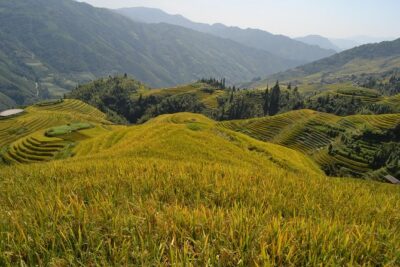
Longji Rice Terraces with Minority Village Private Day Tour
Read our review →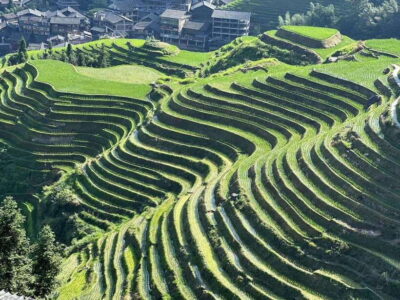
Longji Rice Terraces: Full-Day Private Tour from Guilin
Read our review →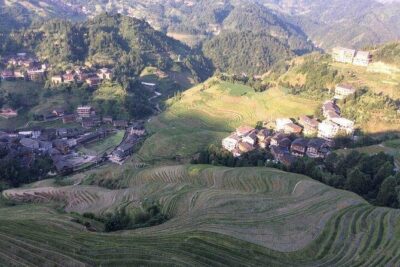
1-DAY Private Longji Rice Terraces and Minority Villages Tour
Read our review →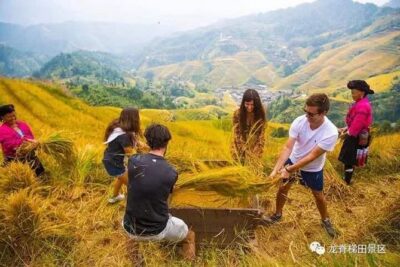
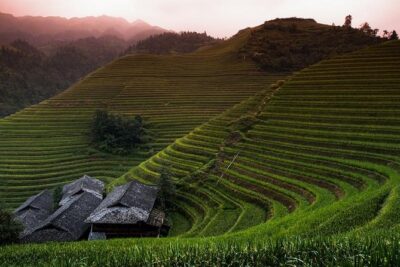
Mini Group: Longji Rice Terraced Fields and Minority Villages Tour
Read our review →
Longji Rice Terraces& Long Hair Village Private Tour
Read our review →
Small Group: Longji Rice Terraces & Minority Village Tour
Read our review →
From Guilin/Yangshuo: Longji Rice Terraces and Ethnic Minority Village Day Tour
Read our review →Browse the lists this tour appears in