
Review · JAPAN
Miyajima Guided Tour and Fresh Oyster Farm Tour
The best part of this Miyajima outing comes after the shrine: you board a small boat, view the Great Torii from the water, pass Hiroshima’s oyster rafts, then grill fresh oysters at Shimada Suisan. It connects Miyajima’s famous sights with the food that gives this part of Japan its local character.
I like the small group of no more than eight, which makes an English-speaking guide much more useful inside the shrine. I also like the clear mix of culture, free time, boat scenery, and lunch. The main drawback is the tight schedule: one hour at the shrine and one hour for shopping leave little room to wander beyond the central sights.
Key points
- Fresh oysters with a hands-on lunch: Grill your own oysters at Shimada Suisan after learning about local oyster farming.
- A different view of the Great Torii: The cruise lets you see Itsukushima Shrine’s famous gate from the sea.
- A useful cultural introduction: The guide explains Japanese worship customs while showing you Itsukushima Shrine.
- Good for solo visitors: Solo bookings are accepted, and the small group size makes it easier to meet others.
- Practical half-day format: The 9:00 a.m. start, included ferry, charter boat, shrine admission, lunch, and return to Miyajimaguchi keep the day simple.
- Weather matters: The cruise depends on safe conditions, so poor weather can lead to a new date or a full refund.
Why this Miyajima tour feels different
Miyajima is easy to reduce to two postcard images: the red Great Torii and the shrine behind it. This tour gives you both, but it also explains how the island is used and worshipped, then links the visit to Hiroshima’s oyster industry.
That connection is the real strength. You are not only looking at the sea from the shore. You take a boat toward the Great Torii, see the oyster rafts where Hiroshima’s oysters are raised, and hear about the work from people connected with local production.
The day lasts about four and a half hours. That is long enough for a proper introduction to Miyajima, yet short enough to fit neatly into a busy Hiroshima schedule. You meet at Miyajima-guchi at 9:00 a.m. and finish back at the same meeting point.
The tour costs $97.55 per person. I consider that a fair price if you want a guided shrine visit and the oyster experience, since lunch, ferry transport, a charter boat, admission to Itsukushima Shrine, the Miyajima tourism tax, and one bottle of mineral water are included. It is less attractive if your main goal is simply to see the shrine and shopping street, both of which you could visit without booking a food tour.
More Guided Trips in Japan:
- Uji and Wazuka Matcha Farm Half Day Private Guided Tour
★ 5.0 · 21 reviews - Guided Bike Tour to a Green Tea Farm in Shizuoka (not e-bikes)
★ 5.0 · 5 reviews - Mykonos: Farm, Ano Mera Village, and Beaches Guided Tour
★ 4.4 · 1,283 reviews
Starting at Miyajima-guchi at 9:00 a.m.
Your starting point is at 1 Chome-11 Miyajimaguchi in Hatsukaichi, near public transportation and the ferry connection to Miyajima. Pay close attention to the meeting instructions, since the tour begins on the mainland side rather than deep inside the island.
The included ferry fare removes one small but important task from your morning. You do not need to work out separate ferry tickets for the group, and private transportation is provided for the Miyajimaguchi to Miyajima portion.
The maximum group size is eight people. That matters here because the tour depends on explanation rather than just transport. A guide can answer questions, point out details near the shrine, and keep the group together without the feel of a large coach tour.
Several tour descriptions and comments identify Takeshi-san as a guide who leads this experience. You should not assume he will be your guide on every date, but the feedback consistently highlights friendly explanations and clear English. The guide is especially useful if you want context for customs that are easy to miss when you visit on your own.
Itsukushima Shrine and the meaning behind the gate
The first main stop is Itsukushima Shrine, a UNESCO World Heritage Site. Admission is included, as is the Miyajima tourism tax, so you can concentrate on the visit rather than sorting out extra payments.
The scheduled shrine visit lasts about one hour. That is enough time for a focused introduction, but not enough for a slow, detailed study of every building and side path. I would treat this as a strong first look at the shrine, not a complete exploration of all Miyajima.
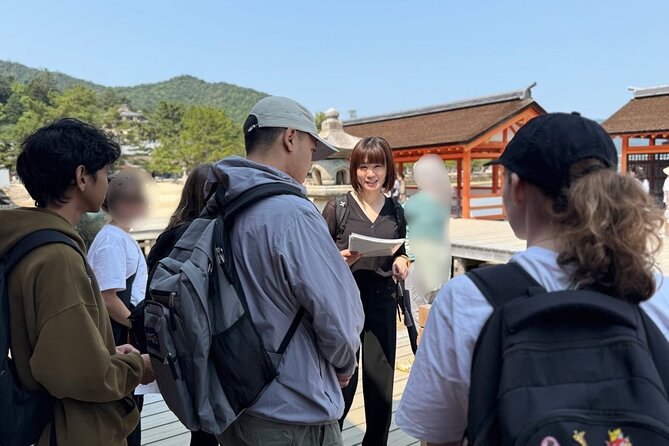
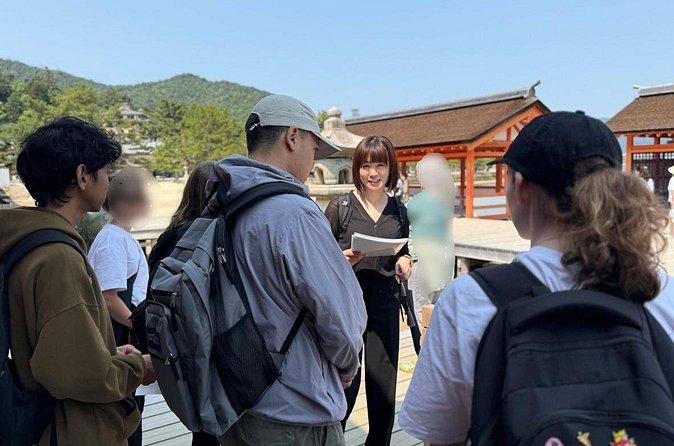
The guide explains Japanese worship traditions and customs as you move through the site. This is valuable because the shrine is more than a bright red structure beside the water. Ritual details, the arrangement of the grounds, and the relationship between the shrine and the sea make more sense when someone explains what you are seeing.
You will also hear about the torii and its place in the approach to the shrine. Seeing the gate from both the shrine area and the later boat ride gives you two useful perspectives. From land, it works as the classic Miyajima photograph. From the water, its position within the bay becomes clearer.
The one-hour limit can feel short if you want many photographs or a quiet visit. If you already know Miyajima well, you may prefer more independent time. If this is your first visit, the guide helps you use those sixty minutes well.
One hour on Omotesando Shopping Street
After the shrine, you get about an hour of free time on Miyajima Omotesando Shopping Street. This is your chance to sample food, browse souvenirs, and choose how much shopping you want to do before lunch.
The free time adds welcome flexibility to a guided morning. You are not kept in a group for every minute, and you can use the break for snacks or small purchases. It also gives you a chance to see the popular commercial side of Miyajima after the quieter cultural explanation at the shrine.
Still, one hour passes quickly. I would not plan a long meal here, since a substantial oyster lunch follows. Use the time for a short walk, food sampling, or a souvenir you genuinely want. You may find the shopping street crowded at busy times, so keeping your plans simple is sensible.
This stop is also where the tour’s limits become clear. Miyajima has more to offer than the central shrine and shopping area, but this half-day schedule does not leave time for a broad island exploration. You will not have an open afternoon for every temple, trail, or outlying attraction.
A few more farm days around Japan worth a look
- Hokkaido Lavender farm & Furano Flower Tour from Sapporo
★ 4.5 · 28 reviews - Mt. Fuji Private Chartered Tour with Nature and Wasabi Farm
★ 5.0 · 24 reviews - Wasabi Farm Walking Tour & Lunch
★ 4.5 · 20 reviews - Hands-on Pearl Harvesting Workshop!
★ 3.3 · 11 reviews
Seeing the Great Torii from the sea
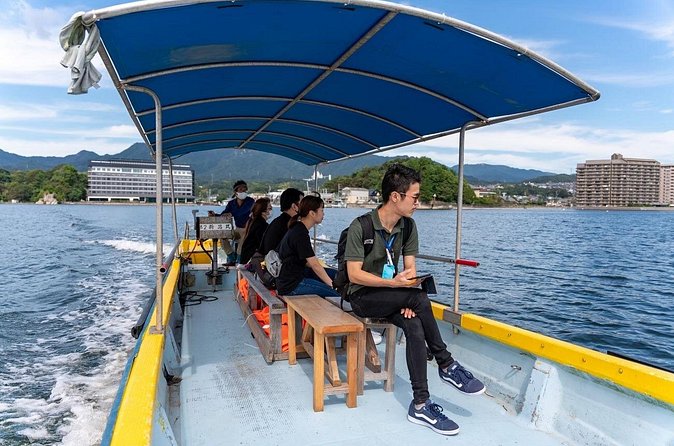
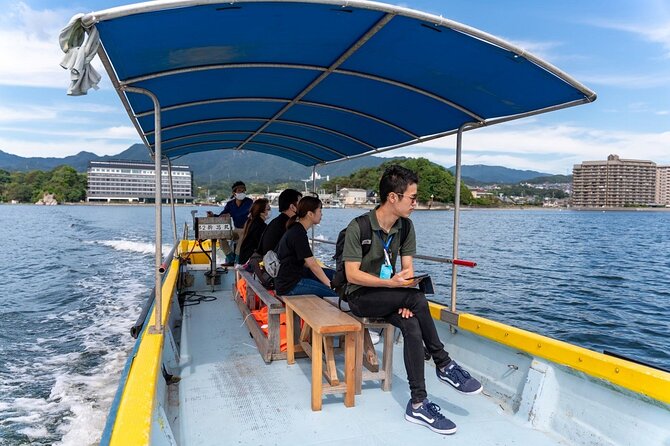
The next stage is the most unusual sightseeing element: a cruise from Miyajima toward Shimada Suisan. The charter boat provides close views of the Great Torii from the water and gives you a way to understand the shrine’s setting beyond the usual shore photograph.
The water-level view changes the scale of the torii. From land, you tend to frame it as a single object. From the boat, you see how it sits in relation to the bay and the shrine buildings.
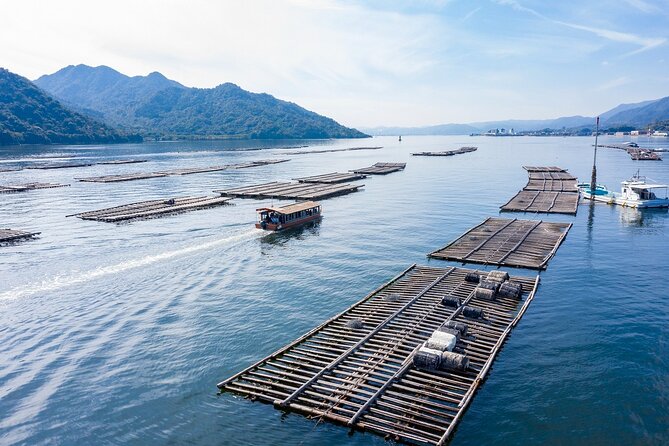
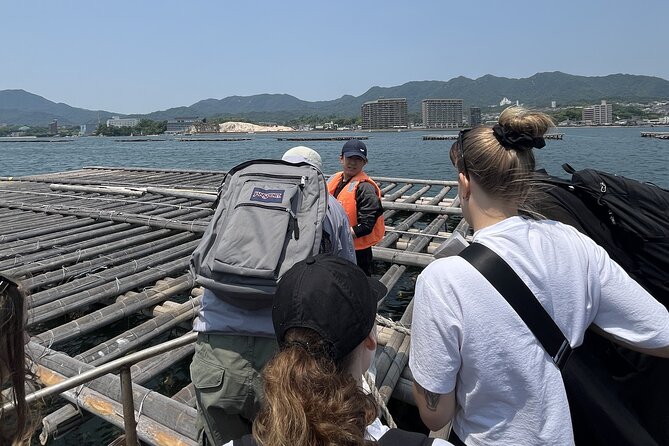
The cruise also brings you near Hiroshima’s oyster rafts. Hiroshima is Japan’s leading oyster-producing region, and these floating structures are part of the working view of the bay. Instead of treating oysters as just a dish at lunch, the tour shows you where the local industry fits into the area.
Commentary comes from local oyster producers, which gives this part a practical focus. You can learn about cultivation while looking at the rafts themselves. That direct link between what you see on the water and what you later eat is one of the tour’s strongest ideas.
The boat portion is also the part most affected by conditions. The experience requires good weather, and poor weather may lead to a different date or a full refund. If the cruise is a major reason you are booking, keep that policy in mind when planning your Hiroshima days.
An oyster lunch at Shimada Suisan
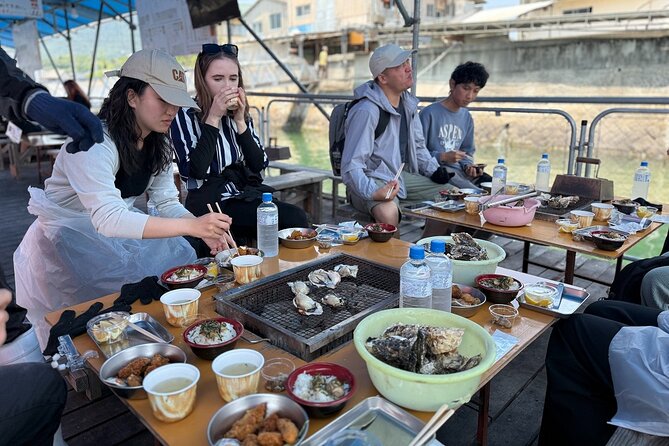
The final stop is Shimada Suisan, where the tour includes an oyster feast lunch and a chance to grill your own oysters. This is not simply a restaurant meal added to a sightseeing route. It is the practical payoff of the boat trip and the farming explanation.
The hands-on cooking makes the lunch more memorable. You get to take part in preparing the oysters rather than receiving them as a finished plate. That can be especially appealing if you enjoy local food experiences and want something more active than a standard set meal.
Lunch is included in the tour price. Drinks during lunch are not included, apart from the supplied mineral water, and alcohol is an extra cost. One optional addition is a bottle of white wine from Hiroshima Miyoshi Winery, listed at 8,000 yen. It was served to world leaders at the G7 Hiroshima Summit, so it may interest wine enthusiasts, but I would regard it as a splurge rather than part of the tour’s basic value.
If you do not drink wine, there is no need to add it. The oysters are the main event, and the package already includes the meal. Personal expenses and other beverages remain your responsibility, so bring a payment method for anything beyond the included food and water.
The lunch stop takes up much of the final two hours, together with the cruise and oyster-farm visit. That is a good use of time if food is central to your trip. It is less suitable if you want a long, quiet walk around Miyajima after the shrine.
What the price includes, and where value depends on you
At $97.55, this is not the cheapest way to visit Miyajima. The value comes from combining several separate pieces in one morning: an English-speaking guide, shrine admission, ferry transport, a charter boat, oyster-farm commentary, lunch, the tourism tax, and bottled water.
I especially like that the charter boat is part of the package. A normal visit to Miyajima gives you the famous view from land, but this experience adds access to the oyster rafts and the water-level approach to the Great Torii.
The group limit also supports the price. Eight people is small enough for a more personal tour, and solo visitors do not need to arrange a private party. The experience accepts solo bookings, which makes it a practical choice if you are traveling alone and want both company and structure for part of the day.
The value is weaker for a visitor who has already explored Itsukushima Shrine and only wants oysters. In that case, you may be paying for a repeat shrine visit and a schedule that leaves little independent time. For a first visit, though, the cultural explanation and food connection make the package easier to justify.
Who should book this four-and-a-half-hour experience
I would choose this tour if you want a guided introduction to Miyajima but do not want to spend a full day on a large group excursion. It suits first-time visitors, solo visitors, couples, and small groups who like local food with a clear sense of place.
It is also a good fit if you have already seen photographs of the Great Torii and want a more useful visit than simply arriving, taking pictures, and leaving. The guide’s explanations about worship customs add meaning to the shrine, while the oyster cruise gives you a side of Hiroshima that many standard sightseeing routes miss.
Families may appreciate the short overall duration and the grilling activity, though the supplied information does not give a specific age policy. Most people can participate, and service animals are allowed. If you have mobility concerns, contact the provider before booking because the published details do not explain the walking surface, boat access, or arrangements for mobility equipment.
I would skip it if your priority is a flexible, unplanned day. The schedule is fixed around the 9:00 a.m. start, one hour at the shrine, one hour of free time, and the cruise and lunch. You gain structure and included transport, but you give up the freedom to linger.
The tour ends back at the original meeting point. That makes it easier to plan the rest of your day, but remember that the listed duration is approximate and weather affects the boat portion.
Booking details worth checking before you go
You receive confirmation when you book, and a mobile ticket is available. Bookings are accepted until 3:00 p.m. on the day before the tour, subject to availability.
Cancellation is free if you cancel at least 24 hours before the 9:00 a.m. start time. Changes or cancellations inside that window are not accepted for a refund. The cut-off follows local time in Japan.
Because the cruise needs good weather, the operator may cancel for poor conditions. In that case, you are offered another date or a full refund. I would avoid placing this tour on the only day of your Hiroshima stay if the boat experience is essential to you.
Should you book the Miyajima shrine and oyster tour?
Book it if you want Miyajima culture and Hiroshima food in one compact morning. The strongest reasons are the small group, useful shrine explanations, boat view of the Great Torii, look at working oyster rafts, and hands-on lunch at Shimada Suisan.
The main trade-off is time. You will see the central sights, but you will not have a leisurely day to explore the whole island. At $97.55, the tour makes the most sense for a first visit, solo visitors, and anyone who values included transport and a local food experience over complete independence.
If that sounds like your style, this is a well-balanced way to meet Miyajima: begin with worship and architecture, move through the shopping street, then finish with oysters tied directly to the waters around the island.
FAQ
Where does the tour begin?
The tour begins at 1 Chome-11 Miyajimaguchi, Hatsukaichi, Hiroshima 739-0411, Japan, at 9:00 a.m.
Where does the tour end?
The activity ends back at the original meeting point.
How long does the tour last?
The tour lasts approximately 4 hours and 30 minutes.
Is lunch included?
Yes. Lunch at Shimada Suisan, including the oyster feast and grilling experience, is included.
Is the ferry to Miyajima included?
Yes. Private transportation from Miyajimaguchi to Miyajima and the Miyajima ferry fare are included.
Are drinks included with lunch?
One bottle of mineral water is included. Other beverages are not included, and alcohol costs extra. White wine from Hiroshima Miyoshi Winery is available for 8,000 yen.
Can solo visitors book this tour?
Yes. Solo bookings are accepted until 3:00 p.m. on the day before the experience.
What happens if bad weather cancels the tour?
If poor weather causes a cancellation, you are offered a different date or a full refund.
Just added around Japan
- From Tokyo Mt.Fuji, Lake Kawaguchi, Makaino Farm day tour★ 5.0 · 8 reviews
- Hida Private E-Bike Tour with Premium Lunch and Farm Experience★ 5.0 · 7 reviews
- Guided Bike Tour to a Green Tea Farm in Shizuoka (not e-bikes)★ 5.0 · 5 reviews
- Hokkaido Farm Tomita Shikisai Hill Waterfall& Blue Pond Day Tour★ 3.5 · 6 reviews
- Autumn Leaves in AutumnSkiing in winterLet’s go to Hoheikyo Onsen by private car (from Sapporo)★ 4.5 · 8 reviews
- E Bike in Yuzawa Mountain Views Lake Daigenta and Rice Terraces★ 5.0 · 2 reviews
- Wasabi Farm Walking Tour & Lunch★ 4.5 · 20 reviews
- 7hr Private Wazuka True Hidden Kyoto Matcha Farm Experience★ 5.0 · 3 reviews
Japan Farm Tours, compared.

Hokkaido Lavender farm & Furano Flower Tour from Sapporo
Read our review →
Mt. Fuji Private Chartered Tour with Nature and Wasabi Farm
Read our review →
Uji and Wazuka Matcha Farm Half Day Private Guided Tour
Read our review →
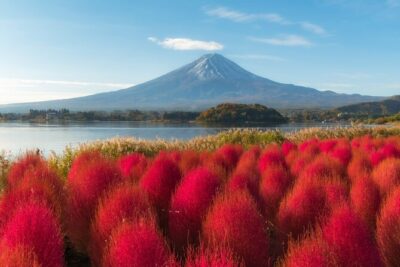
From Tokyo Mt.Fuji, Lake Kawaguchi, Makaino Farm day tour
Read our review →
Hida Private E-Bike Tour with Premium Lunch and Farm Experience
Read our review →Browse the lists this tour appears in