

Review · NEW ORLEANS
New Orleans: Oak Alley Plantation and Katrina City Tour
Oak Alley’s 28 ancient oak trees form one of Louisiana’s most memorable approaches. Their branches make a long green tunnel toward a Greek Revival plantation house, giving you a powerful sense of place before the guided tour even begins. The 75-minute drive from New Orleans also takes you into the Mississippi River country, far from the city streets.
I like two things here: you get a proper guided visit inside Oak Alley, not just a photo stop, and the New Orleans portion tackles Hurricane Katrina and the city’s rebuilding instead of sticking to postcard sights. The mix of plantation history, cemeteries, architecture, and modern recovery gives you a fuller picture of the region.
The weak point is tour consistency. The Oak Alley portion has earned the strongest praise, while pickup problems and an uneven city guide have caused real frustration. The published details also include a Jean Lafitte National Historical Park and Preserve boat segment, so confirm exactly what will run on your date.
Key points at a glance

- The oak-lined entrance is the visual centerpiece: Twenty-eight oaks older than the 19th century lead toward Oak Alley’s main house.
- Oak Alley includes a guided house visit: You’ll see original features, plantation-era objects, and antique farm equipment with a guide in period-style clothing.
- Katrina is part of the main story: The three-hour city tour visits the Lower 9th Ward and explains how residents are rebuilding.
- You cover several New Orleans districts in one ride: Expect Jackson Square, St. Louis Cathedral, Esplanade Avenue, City Park, St. Charles Avenue, and the Garden District.
- Cemeteries are part of the walking portion: Entry to St. Louis Cemetery No. 3 is included, with an explanation of above-ground burial traditions.
- Pickup is convenient but needs attention: Be outside during the 8:15 to 8:45 AM window and look for an Alert Transportation bus.
Oak Alley begins with a long road into plantation country

This is a full-day outing, lasting about 510 minutes, or eight and a half hours. Pickup is offered from a very large range of New Orleans hotels and meeting points, with the first pickup window running from about 8:15 to 8:45 AM.
The drive to Oak Alley takes about 75 minutes. That matters when planning your day. You are not squeezing in a quick side trip between breakfast and lunch. You are giving most of a day to the plantation and the city tour, with a fair amount of time spent in the minibus.
The vehicle is air-conditioned, a welcome detail in Louisiana. Still, bring water, wear shoes you can walk in, and plan for heat once you leave the vehicle. Walking is required at Oak Alley and during the cemetery visit.
Oak Alley sits in Vacherie near the Mississippi River, roughly 70 miles from the French Quarter. The road trip helps explain why plantation tours are usually best treated as a full-day experience. The plantation district is outside central New Orleans, and the distance gives the visit a different setting from the city’s tightly packed streets.
More Plantation Tours in New Orleans
- Swamp Boat Ride and Oak Alley Plantation Tour from New Orleans
★ 5.0 · 3,303 reviews - Oak Alley Plantation Tour with Transportation from New Orleans
★ 4.5 · 1,747 reviews - Whitney Plantation Tour with Transportation from New Orleans
★ 4.5 · 1,351 reviews
The oak avenue gives Oak Alley its name
The famous entrance is the first major sight. Twenty-eight oak trees, said to predate the 19th century, line the route toward the house. Their wide limbs create a shaded passage that photographs well, but the trees are more than a backdrop. They frame the property’s scale and show how carefully the main approach was designed.
Take your time here if the schedule allows. The view is strongest when you look straight down the avenue toward the house, but it is also worth noticing the contrast between the heavy tree canopy and the bright open grounds around it.
The plantation is known for its antebellum restoration, and the main building is a 19th-century Greek Revival house. The architecture is formal and symmetrical, with the kind of broad presence you expect from a grand Southern estate. The guided visit helps connect the house’s design with the people who lived and worked there.
Inside the Greek Revival house

The house tour is guided rather than self-directed. Your guide wears plantation-era clothing and leads you through the restored rooms, pointing out original features and explaining plantation life.
That format gives you a chance to ask questions and hear the site’s story in sequence. It also means your experience can depend heavily on the individual guide. The local Oak Alley guide has received the warmest praise in the available feedback, especially for being professional and well prepared.
Keep your expectations grounded. A plantation house can be impressive while also representing a painful system built on enslavement. The value of the visit comes from looking at both sides: the architecture and wealth on display, and the human cost that made that wealth possible. Oak Alley’s guided format gives you a place to ask for context rather than simply admiring the columns.
The grounds also include antique farm machinery. These objects help shift the visit away from the main house and toward the work that sustained the property. You may find the machinery less polished than the house, but it adds a useful reminder that plantation life was not only about grand rooms and oak trees.
There is a restaurant and a shop on site. Food is not included in the tour price, so you should budget separately if you plan to eat there. The supplied details do not specify a meal break or menu, so do not assume lunch is part of the package.
The New Orleans portion moves from landmarks to lived experience
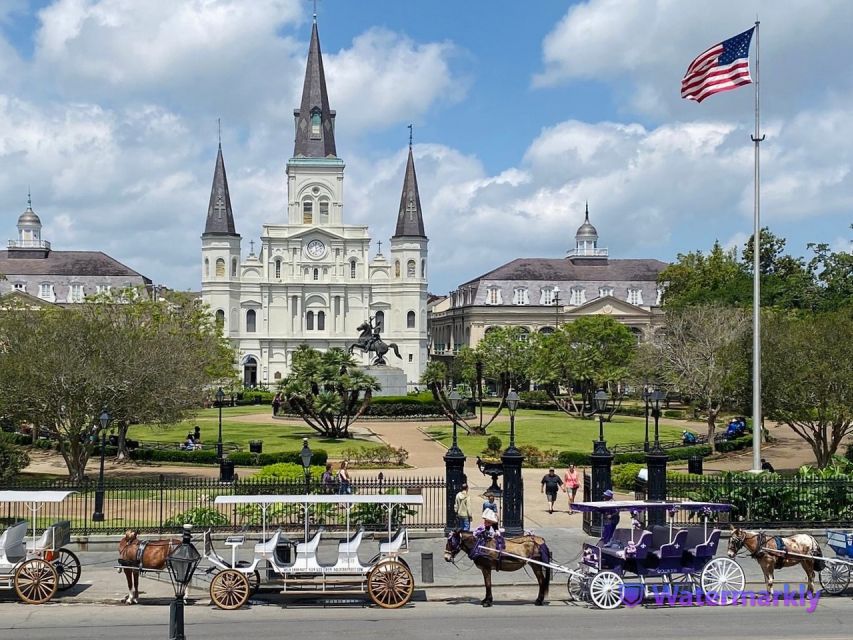
The city segment lasts three hours and uses an air-conditioned minibus. It is designed as a broad introduction rather than a long visit at each attraction.
You begin around the French Quarter and its central landmarks. Jackson Square gives you the classic view of St. Louis Cathedral and the surrounding historic buildings. Nearby, The Cabildo recalls the Spanish colonial period and the former city government. This is a useful opening because you see the city’s oldest civic center before moving into other neighborhoods.
You should think of this section as a guided orientation. You will see places you can later return to on foot, but you will not have unlimited time to explore interiors or linger at every stop. If this is your first visit to New Orleans, the route can help you decide which areas deserve a separate afternoon.
The bus then passes century-old houses along Esplanade Avenue on the way toward City Park. The route reaches the Dueling Oaks, a place tied to old New Orleans customs and local stories. The city’s architecture changes along the way, and the ride lets you compare the compact French Quarter with the wider, tree-lined avenues beyond it.
More Plantation Tours in the USA
- Laura Creole Plantation Guided Tour
★ 5.0 · 1,279 reviews - Airboat and Plantations Tour with Gourmet Lunch from New Orleans
★ 4.5 · 1,246 reviews - New Orleans: Bayou Swamp Tour and Oak Alley Plantation Tour
★ 4.7 · 1,147 reviews - New Orleans: Oak Alley Plantation & Airboat Swamp Combo Tour
★ 4.7 · 906 reviews
St. Louis Cemetery No. 3 explains the city’s above-ground graves
The cemetery visit is one of the more useful stops because you get out and walk. Entry to St. Louis Cemetery No. 3 is included.
Above-ground tombs are a defining feature of New Orleans burial grounds. The tour explains why this tradition developed, rather than leaving you to guess from the rows of tombs. The cemetery is not just an atmospheric photo stop. It shows how water, ground conditions, family customs, and Catholic traditions shaped the city’s relationship with death.
Wear comfortable shoes. The tour requires walking, and the full day can feel tiring by this point, particularly in warm weather. You also need to be respectful in the cemetery. This is an active burial place, not simply an outdoor museum.
St. Charles Avenue and the Garden District show another New Orleans

The route continues along St. Charles Avenue into the American side of New Orleans. This portion gives you grand homes, broad streets, and a different architectural mood from the French Quarter.
The Garden District is especially useful for first-time visitors who want to understand the city beyond Bourbon Street. You pass elegant residences and the home associated with Gothic fiction writer Anne Rice. The tour does not promise an interior visit, so think of this as a narrated drive with selected views.
I like this contrast. New Orleans is not one historic quarter repeated for visitors. It is a patchwork of French, Spanish, Creole, American, Caribbean, and modern influences, and the route gives you a quick look at that variety without requiring several separate tours.
The drawback is time. A minibus can show you the avenue and explain what you are seeing, but you will not get the same feel as walking several blocks at your own pace. Use the tour to take notes about places you want to revisit.
The Lower 9th Ward puts Katrina in the foreground

The most serious part of the city tour is the visit to areas hit hard by Hurricane Katrina, including the Lower 9th Ward. Here, the guide discusses the storm’s impact and the long work of recovery.
This subject gives the tour more purpose than a standard sightseeing loop. You are not only seeing old buildings and grand avenues. You are hearing about displacement, damage, and the efforts of residents to rebuild their communities.
The quality of this section depends on how the guide handles it. A good explanation should give you clear local context and treat residents with respect. Feedback about the city driver-guide has been sharply mixed, including complaints about an arrogant manner, offensive comments about French people, and changes to the planned route without explanation. That is not a minor issue when the tour deals with a disaster that affected real families.
I would book this experience for the route and subject matter, but I would not assume the guiding will be equally strong in every part of the day. If Katrina recovery is your main reason for booking, ask at the start how much time will be spent in the Lower 9th Ward and what the guide plans to cover.
A possible Jean Lafitte boat segment needs confirmation
The schedule supplied for this experience also includes Jean Lafitte National Historical Park and Preserve, with a boat cruise and wildlife viewing lasting about 100 minutes. The main description focuses on Oak Alley and the three-hour city and Katrina tour, while the listed inclusions specifically name the city tour, cemetery, and plantation entry.
That mismatch matters. A boat ride would change the timing and shape of the day, and it could affect how much time you have for the city neighborhoods. Contact the operator before booking and ask if the Jean Lafitte segment runs on your date, if it replaces part of the city tour, and whether the boat is included in the $120 price.
Do not build your day around wildlife sightings until you have that answer. The confirmed core of the experience is the plantation visit plus the New Orleans city and Katrina tour.
Is $120 a fair price?
At $120 per person, the value depends on how much you would otherwise spend on transport and separate admissions. Hotel pickup and drop-off, an air-conditioned minibus, a licensed guide, Oak Alley admission, the cemetery entry, and a three-hour city tour are included.
Oak Alley is far enough from New Orleans that arranging transport on your own can be inconvenient. The tour also combines two experiences that are often booked separately: a plantation visit and a broad city orientation. For a first-time visitor with only one full day available, that combination can make financial and practical sense.
The tradeoff is depth. You are not getting a slow, private tour of the plantation or a detailed neighborhood walk. You are getting a packed overview with substantial driving. Food and drinks cost extra, and the schedule may feel long if you prefer to explore one place carefully.
I see this as decent value for someone who wants range and convenience. It is weaker value for someone mainly interested in a polished, highly personal guide or a quiet plantation visit.
Pickup details can make or break the morning
Pickup is offered at many hotels and selected meeting points across New Orleans. You are given a 30-minute window, roughly 8:15 to 8:45 AM, rather than one exact minute.
Be outside and ready before the window begins. Look for a bus marked Alert Transportation. Keep your phone available, and make sure the operator has the correct hotel or meeting point.
This is worth taking seriously because pickup has been a problem for some bookings. The driver reportedly missed passengers twice on one occasion, and another pickup attempt failed before the booking company refunded the first tour. Communication was also described as difficult because the operator does not use WhatsApp.
That does not mean your pickup will fail, but it does mean you should not wander into the lobby or assume the vehicle will wait. If no bus appears by the end of the window, contact the provider promptly and record the time and location.
Who should book this full-day combination?
I would choose this tour if you have limited time in New Orleans, want to see Oak Alley without arranging a car, and prefer a guided overview to independent planning. It suits you especially well if the Lower 9th Ward and Katrina recovery are important parts of your understanding of the city.
It also works for people who want variety. In one day, you get plantation architecture, oak trees, farm equipment, cemetery customs, French Quarter landmarks, Garden District homes, and post-Katrina neighborhoods.
I would hesitate if you dislike long vehicle rides, need a relaxed schedule, or want deep historical treatment at every stop. I would also think twice if you are sensitive to poor customer service or need firm control over the day’s route.
Book only after confirming the Jean Lafitte boat segment and the exact pickup plan. That small check could prevent a large mismatch between what you expect and what runs.
Should you book it?
Book this tour if Oak Alley is your priority and you want the convenience of hotel transport, a house tour, and a quick but serious look at Katrina’s impact. The plantation visit is the strongest part, and the range of New Orleans sights gives you useful orientation.
Skip it if you want a slow city walk, a consistently polished guide, or a tightly controlled schedule. The $120 price is reasonable for transport and several admissions, but the uneven city guiding and reported pickup failures mean you should reserve with realistic expectations and confirm the day’s exact program first.
FAQ
How long does the tour last?
The experience lasts about 510 minutes, or eight and a half hours.
What time is pickup?
Pickup takes place during a 30-minute window from about 8:15 AM to 8:45 AM. You should be outside your accommodation and look for an Alert Transportation bus.
Is hotel pickup and drop-off included?
Yes. Pickup and drop-off are included from a large selection of New Orleans hotels and meeting points.
How long is the drive to Oak Alley?
The drive takes approximately 75 minutes. Oak Alley is in Vacherie near the Mississippi River, about 70 miles from the French Quarter.
Is food included?
No. Food and drinks are not included. Oak Alley has a restaurant and shop on site.
Does the tour include a cemetery visit?
Yes. Entry to St. Louis Cemetery No. 3 is included, along with a guided explanation of New Orleans’ above-ground burial tradition.
Is a Jean Lafitte boat cruise included?
The schedule includes a 100-minute Jean Lafitte National Historical Park and Preserve boat cruise with wildlife viewing, but the main tour description centers on Oak Alley and the city and Katrina tour. Confirm with the operator whether the boat segment runs on your date and how it affects the route.
Just added around New Orleans
- Whitney Plantation Tour with Transportation★ 4.0 · 29 reviews
- Whitney Plantation and Soul of New Orleans City Tour Combo★ 5.0 · 13 reviews
- St. Joseph and Felicity Plantation Combo Tour★ 5.0 · 4 reviews
- St. Joseph Plantation Tour★ 4.5 · 30 reviews
- Two Plantation Tour: Oak Alley and Laura or Whitney★ 5.0 · 7 reviews
- Private Airboat Ride and Plantations Tour with Gourmet Lunch from New Orleans★ 5.0 · 50 reviews
- Small Airboat and Oak Alley Plantation Tour from New Orleans★ 4.5 · 23 reviews
- N’awlins Luxury: Laura, Oak Alley or Whitney Plantation Tour w/Transportation★ 4.5 · 46 reviews
New Orleans Farm Tours, compared.

Swamp Boat Ride and Oak Alley Plantation Tour from New Orleans
Read our review →
Oak Alley Plantation Tour with Transportation from New Orleans
Read our review →
Whitney Plantation Tour with Transportation from New Orleans
Read our review →

Airboat and Plantations Tour with Gourmet Lunch from New Orleans
Read our review →
Bayou Swamp Tour and Oak Alley Plantation Tour
Read our review →
Oak Alley Plantation and Large Airboat Swamp Tour from New Orleans
Read our review →
Browse the lists this tour appears in